The Agateon Blog
Engineering notes from inside the gate
How we orchestrate AI agents — and how we know when to trust them. Mechanisms, retrospectives, and the failures that shaped them.
Latest · 2026-10-09 · 8 min read
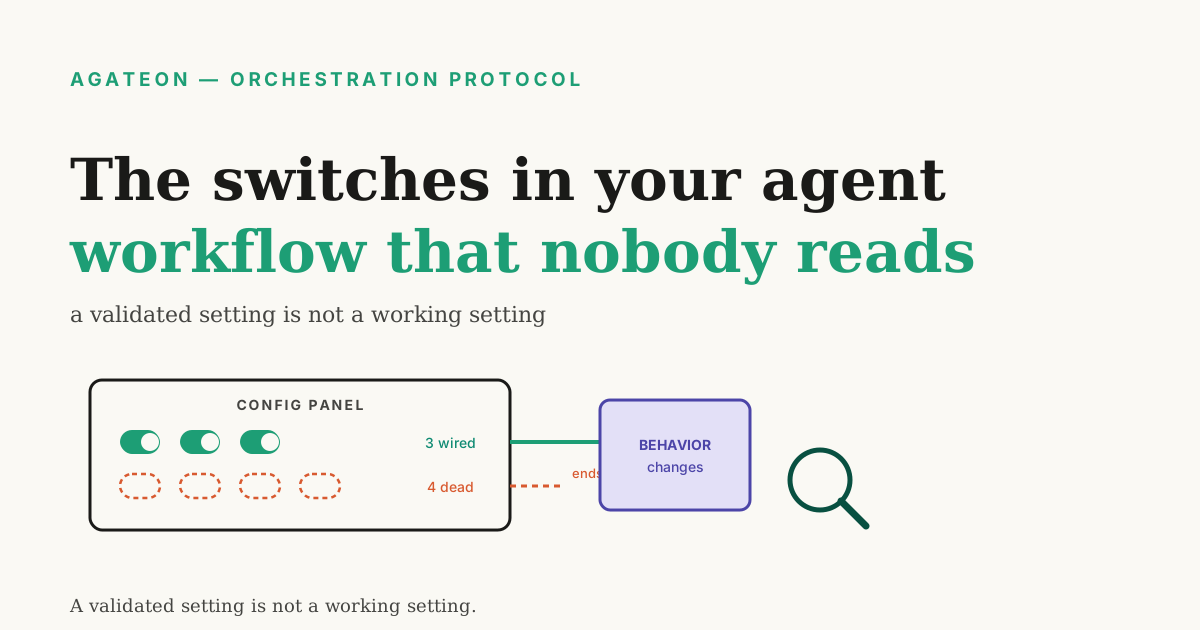
The switches in your agent workflow that nobody reads
Config that gets validated is not config that gets used. A three-step audit for finding dead switches in your own agent workflow — plus what happened when we ran it on ours, including the part where our first diagnosis turned out to be wrong.
Read the post →2026
- 09-19Should your agent workflow use a protocol at all?A decision framework for how much process your agent workflow actually needs: score the evidence instead of trusting anyone's complexity claim, make the claim checkable in one direction, and know when to skip all of it. Includes a five-signal rubric you can compute from a diff today.8 min
- 09-11A new session isn't a new perspectiveYou moved your agent's code review into a fresh session with no author context — and it still missed what a differently-trained reviewer would have caught, because it runs on the same model as the author. Same training distribution, same systematic blind spots. v0.71.0 ships the fix's missing axis: route any (phase, role) to a different model or a different CLI, with fallback rules that make judge-shopping impossible. Plus the three-question audit for your own pipeline.7 min
- 09-07No agent grades its own homeworkAsk the agent that just fixed the bug whether it's really fixed and you get 'verified, definitely' — zero information, because the reviewer shares the author's context. The fix that holds is structural: fresh subagents, an independent judge, thresholds that are exit codes instead of opinions. Plus the three-question audit that finds every producer-judge in your agent loop.7 min
- 09-05Give your AI agent a flight recorderMost teams can't say how many agent tasks ran, how many checks stopped one, or how much work got redone — memory doesn't survive contact with real workloads. Here's the minimal event log we built, what it revealed (including where it lies and what it can't see), and how to steal it in an afternoon.7 min
- 09-03You can't delegate what you can't verifyThe ceiling on what you hand to an AI agent is not the model's capability — it's how much of its work you can check. Supervision is a trust tax. Verification is the way out.6 min
- 08-31We keep trying to break our own gatesA gate is only trustworthy if someone keeps trying to break it. How Agateon attacks its own verification: classifying TDD red lights, separating the judge from the author, and never letting an LLM be the final word.8 min
- 08-30The right to look away: how gates buy autonomyGates are usually sold as extra oversight. The payoff is the opposite: once progress is checked against evidence the agent can't fake, the machine can advance on its own, and your attention is only spent at decision points the state machine designs on purpose.7 min
- 08-28Is it done, or does it just look done? A ladder of evidence for AI-agent workA ranked framework for judging whether an AI agent actually finished a phase — from self-report up to immutable git history — with an audit checklist for finding the self-reports hiding in your own gates.10 min
- 08-27Agateon: verify AI agents the way a build system verifies a compilerAn orchestration protocol that gates AI-agent progress on objective evidence — test exit codes, git history, files on disk — instead of the agent's own report. No runtime. State in version-controlled Markdown.6 min
- 08-26Our AI Safety Net Depended on the Agent Being Honest. It Wasn't.A postmortem on a safety mechanism that depended on the same agent it was meant to verify — and the fix that anchored the check to git history instead.6 min